

Following on from last week’s Insights piece where we looked at the yield curve changes for Venezuela, Colombia and Mexico, this time we examine at the the reaction across the US curve.
To recap: the US undertook military action against Venezuela on the morning of 3 January 2026 and since then, there have been plenty of other geopolitical events, most of which have at least some relevance to the US.
On the morning of Saturday 3 January 2026, the US launched an operation to capture Venezuelan leader Nicolas Maduro and his wife Cilia Flores, both were apprehended and transferred to the US to face drug trafficking charges.
Whilst it remains unclear if there will be a long-term impact on US debt and the domestic economy, we can see what the bond markets think so far (in Chart 1).
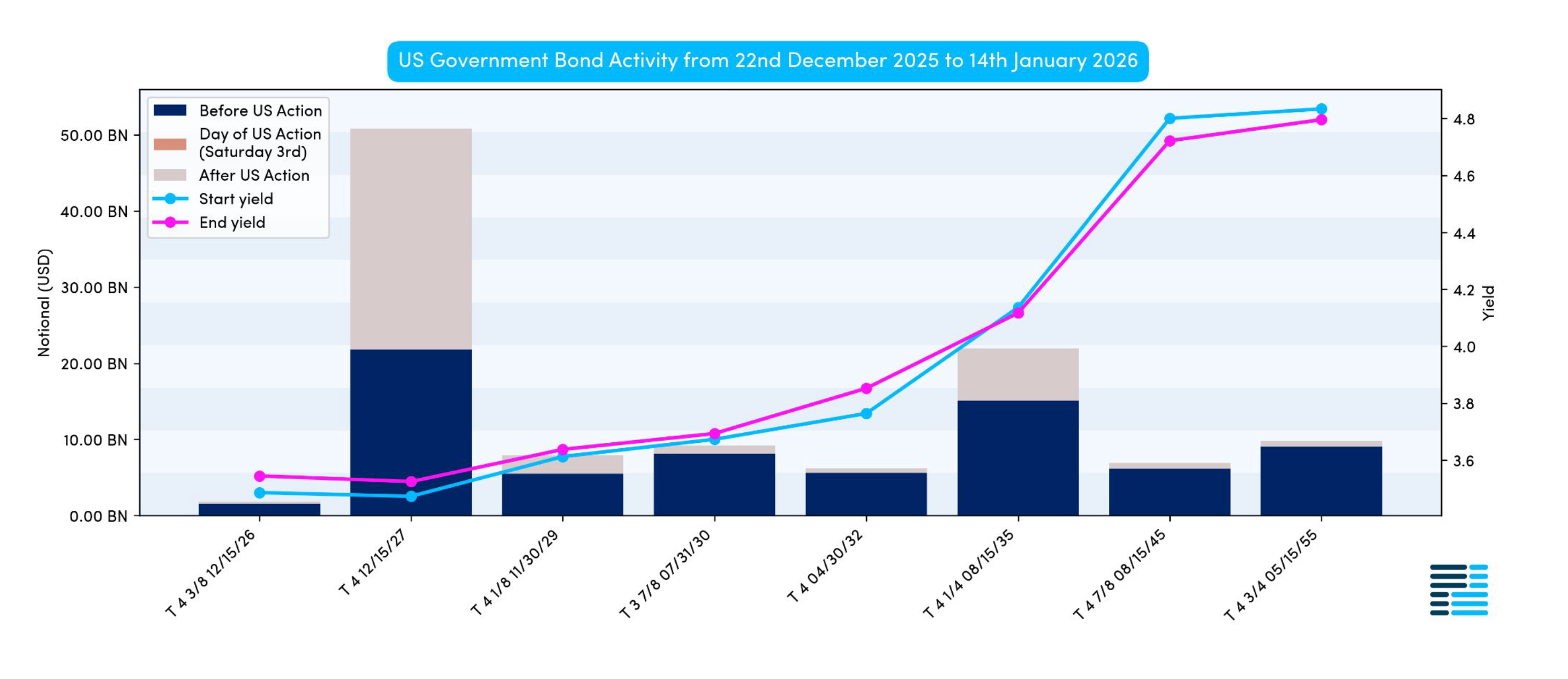
As shown above, the bulk of activity since early January has been concentrated at the front end, with the T 4% 12/2027 being the only issue to have higher flows in 2026 than the last two weeks of December 2025.
It is not uncommon for front-end bonds to trade in much larger size than longer dated bonds due to the associated risk (a one-basis point movement is typically more costly for longer-dated bonds); therefore, we cannot read to much into this. However, the curve has flattened slightly (front-end yields have risen and long-end yields have dropped), which is perhaps more telling and suggests that there could be a small element of concern in the short term.
When it comes to post-trade pricing, the US regulator FINRA does not publish intraday activity on US Treasuries, whereas intraday activity for Corporate bonds is available via TRACE. In the past, this has made it difficult for market participants to accurately gauge daily US Treasury activity, particularly for those without access to live quote data.
This has changed recently under the new FCA Transparency regime, with US Treasury transactions on FCA-regulated venues, or reported via FCA-approved publication arrangements (APAs), now reported in real-time for trade sizes of up to 15 million (GBP equivalent).
Chart 2 shows the average daily volumes in USD for US Treasuries and non-sovereign debt, bucketed by the time taken to report the trade.

Prior to the new transparency regime, the vast majority of US Treasury transactions were indefinitely deferred (meaning only a weekly aggregated report was provided). Whilst ESMA-reported transactions still follow this pattern (until March this year), the new FCA regime has resulted in activity being released (with full transaction level detail) in a shorter timeframe.
It should be noted that the longest deferral under the new FCA transparency regime is three months; therefore, although it appears volumes were higher in 2025, this may be partially due to data not yet having been made available (additionally, the time of year may be a factor).
US sovereign debt aside, USD-denominated Corporate and Agency bonds are also being reported in a more timely fashion. As with Treasuries, we do not yet have the full picture due to the longest deferral period, but early indications suggest that TRACE alone may no longer be sufficient to gain the complete picture, and MiFID data appears to be the ideal companion.
1 https://www.reuters.com/world/americas/world-reacts-us-strikes-venezuela-2026-01-03/
2 https://www.csis.org/events/what-just-happened-venezuela-and-what-comes-next

%20(10).png)
%20(9).png)