
.png)
When ESMA launched their new transparency regime on 2 March, most attention focused on the deferral changes; however, the update also included some new flags. This week, we explore the new Trading System field and assess whether it can support analysis of trading flows across both sovereign and corporate bonds.
This means that if a trade occurs on-venue, it should have the flag populated, which can then be used to identify the protocol under which the trade occurred. The possible values are shown in table 1 below.
Having established the definitions, we can now dig into the data, starting with sovereigns since the launch of the new ESMA transparency regime (approximately 8 weeks ago).

From Chart 1, it is clear that activity is fairly evenly split between Central Limit Order Books (CLOB) and Request For Quotes (RFQT). It also indicates that the vast majority of activity is flagged as ‘unknown’, which can be inferred to relate to voice trading activity, off-venue. However, by adding in the venue of execution in Chart 2 below, it becomes evident that, in some cases, on-venue trades are not being populated with a value, which we must assume is simply down to early ‘teething problems’ with the new requirements.

The dynamics in the credit market are quite different to the rates space, as there is far less reliance on order books. Conventional wisdom also suggests a higher proportion of voice activity.

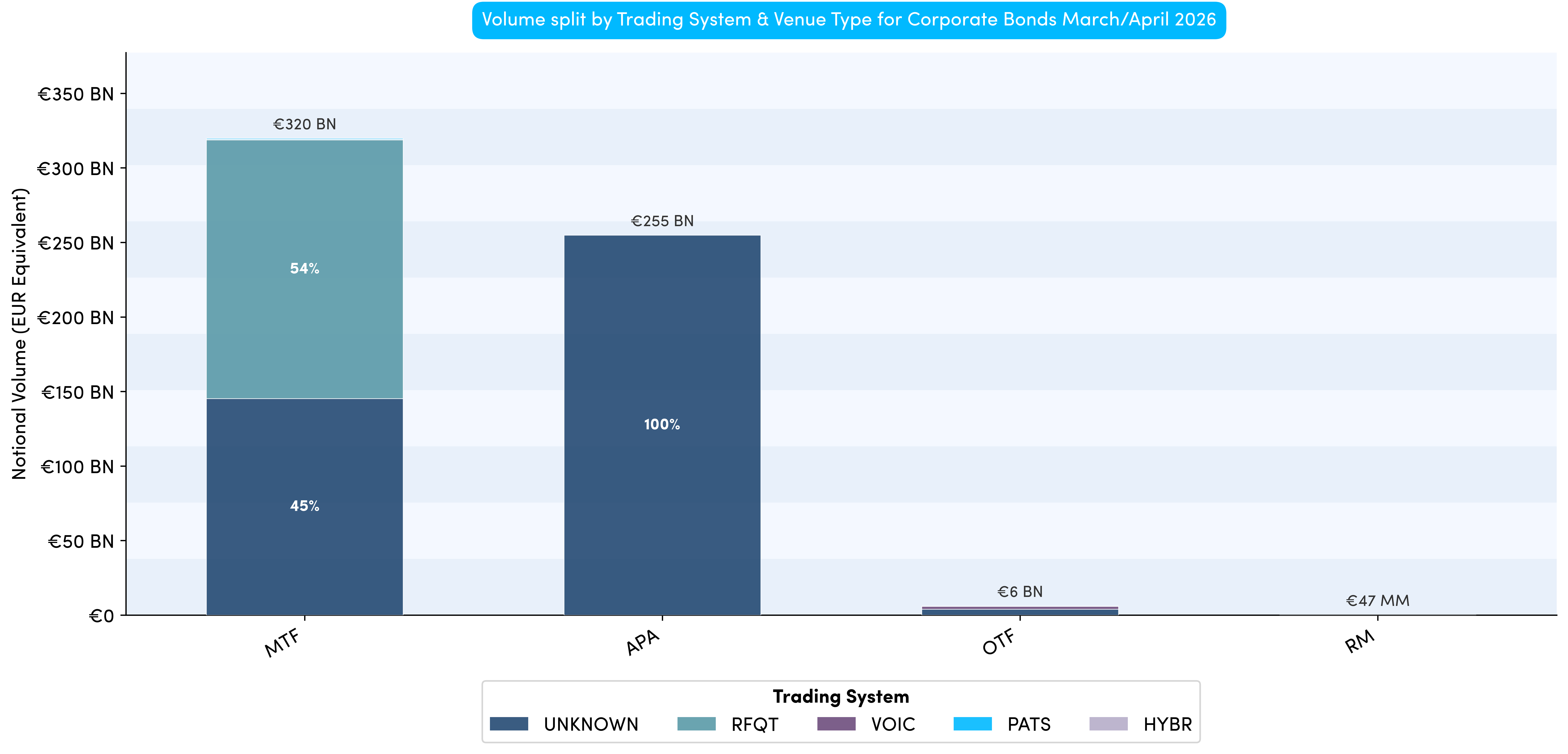
Chart 3 highlights a similar trend to that seen in sovereign activity, with the vast amount of volume still not being flagged. However, a more detailed view (see Chart 4) shows that the percentage of overall volume without a Trading System flag is actually lower than for sovereign trades.
Overall, we can see a higher percentage of volume is reported via APAs (and is therefore assumed to be voice). However, a substantial amount of flow can now be confirmed (rather than presumed) as going via RFQ.
We finish up this week by looking into the breakdowns on a week-by-week basis.
.png)
Chart 5 shows that, for sovereign bond activity, the majority of activity was initially flagged as unknown. However as we now know, this does not necessarily mean it was off-venue. Chart 6 presents the same analysis for credit, where a similar conclusion can be drawn - namely, that some activity was on-venue but reported without a Trading System flag.
The key takeaway is that the proportion of activity remaining as unknown for both rates and credit is shrinking. As awareness and adoption increases, it would be logical to expect this trend to continue.
.png)

%20(10).png)
%20(9).png)