
The UK Bond Consolidated Tape launched on Monday 22nd June, and immediately faced its first challenge, with the UK Prime Minister resigning the same morning!
The UK Bond Consolidated Tape (referred to as CT throughout) went live just after midnight last Monday and was immediately tested with the news that the UK is going to have (yet another) Prime Minister in the not too distant future.
Interestingly at the time of writing, Gilt yields have actually tightened, which feels like an unusual sentence to read in 2026, however the scope of the CT is far wider than just Gilts.
The reporting venues are defined* as follows:
There are unlikely to be any surprises there, so we move on to the covered asset classes which are determined* by CFI Code:
Whilst the tape is referred to as the UK Bond CT, we can see that a more accurate description might be the UK Debt Instruments CT as many ‘bond like’ instruments are also included (these are commonly referred to and treated like bonds by traders and other market participants).
If you were on a trading floor 10 years ago then (assuming you were sitting near equity traders) it was close to impossible to avoid (constantly) hearing about trading in dark pools. Whilst this isn’t quite the same concept, a new trend may emerge with ‘on-tape’ vs ‘off-tape’ activity.

Chart 1 confirms our expectations (outlined in Propellant Insights Issue 39), in that there is a substantial amount of activity occurring in debt instruments, outside the scope of the CT.
Interestingly we did observe a small amount of activity reported via the CT that looked to be on out-of-scope instruments. This is almost certainly caused by different venues using different reference data sets.
It seems likely some contributors classify instruments that show as structured products within the FCA’s Financial Instruments Reference Data System (FIRDS) as standard corporate bonds instead, and therefore report via the CT.
Ignoring out-of-scope activity for a second, we can see that the number of transactions reported via the CT were only slightly lower than those captured via standard MiFID reporting (which is to be expected at this stage as not all contributors are live yet).
Having seen the top level breakdown we next turn our attention to the venues.
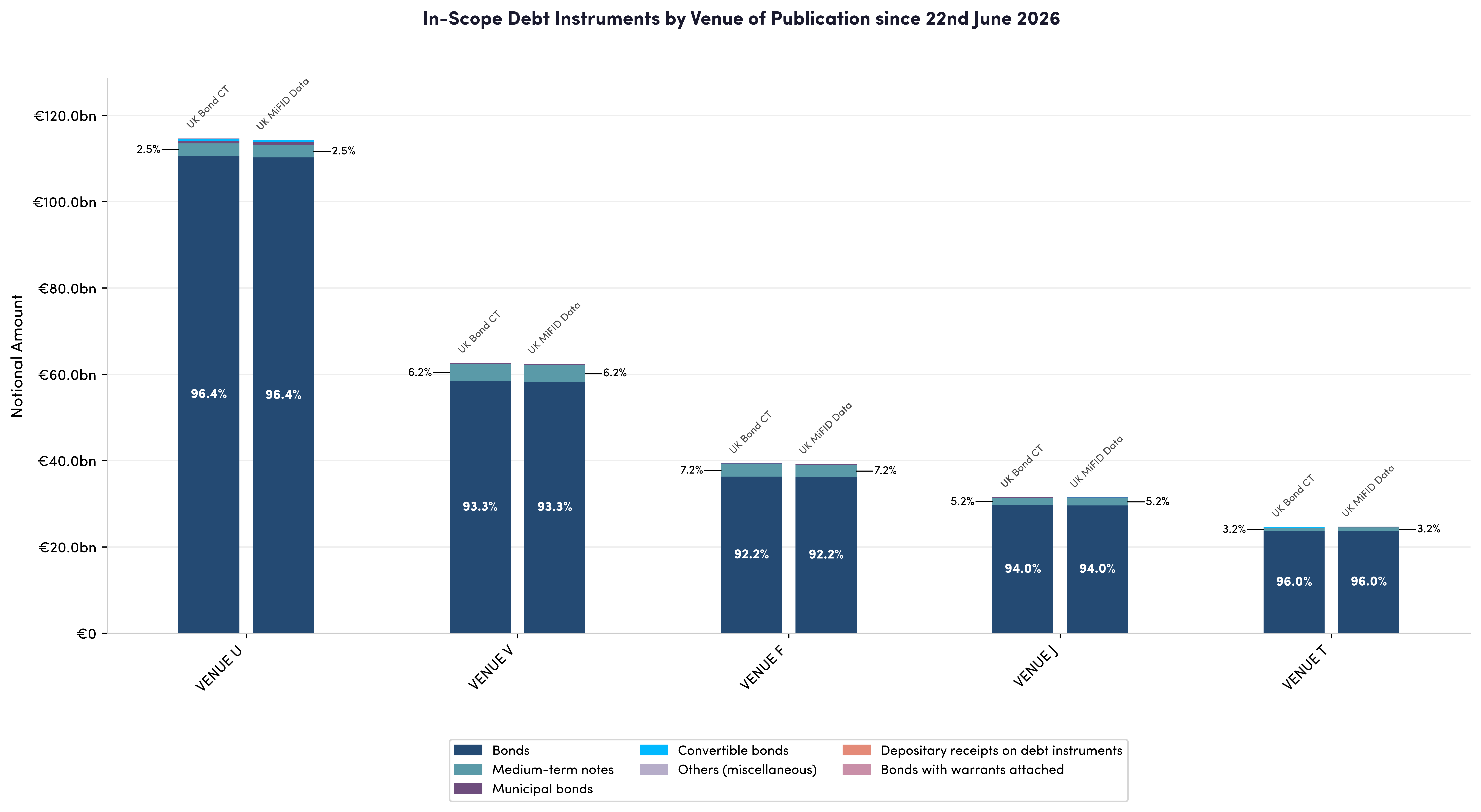
We first look at ‘on-tape’ reporting for venues (i.e. reports that we believe are in-scope for CT reporting). We can see that MiFID reporting is aligned almost perfectly across the board with CT reporting (for easier viewing we only show the 5 largest venues by volume in Chart 2).
This is exactly what we would hope for and it shows the contributors are (generally speaking) submitting reports as expected.
Where it gets interesting is when we look at off-tape (i.e. out-of-scope) reporting. To recap, this is where the CFI Code of an instrument means it is not expected to be reported via the CT.
The following chart shows a venue by venue breakdown for out-of-scope activity (again we take the top 5 by volume) presents some surprises.
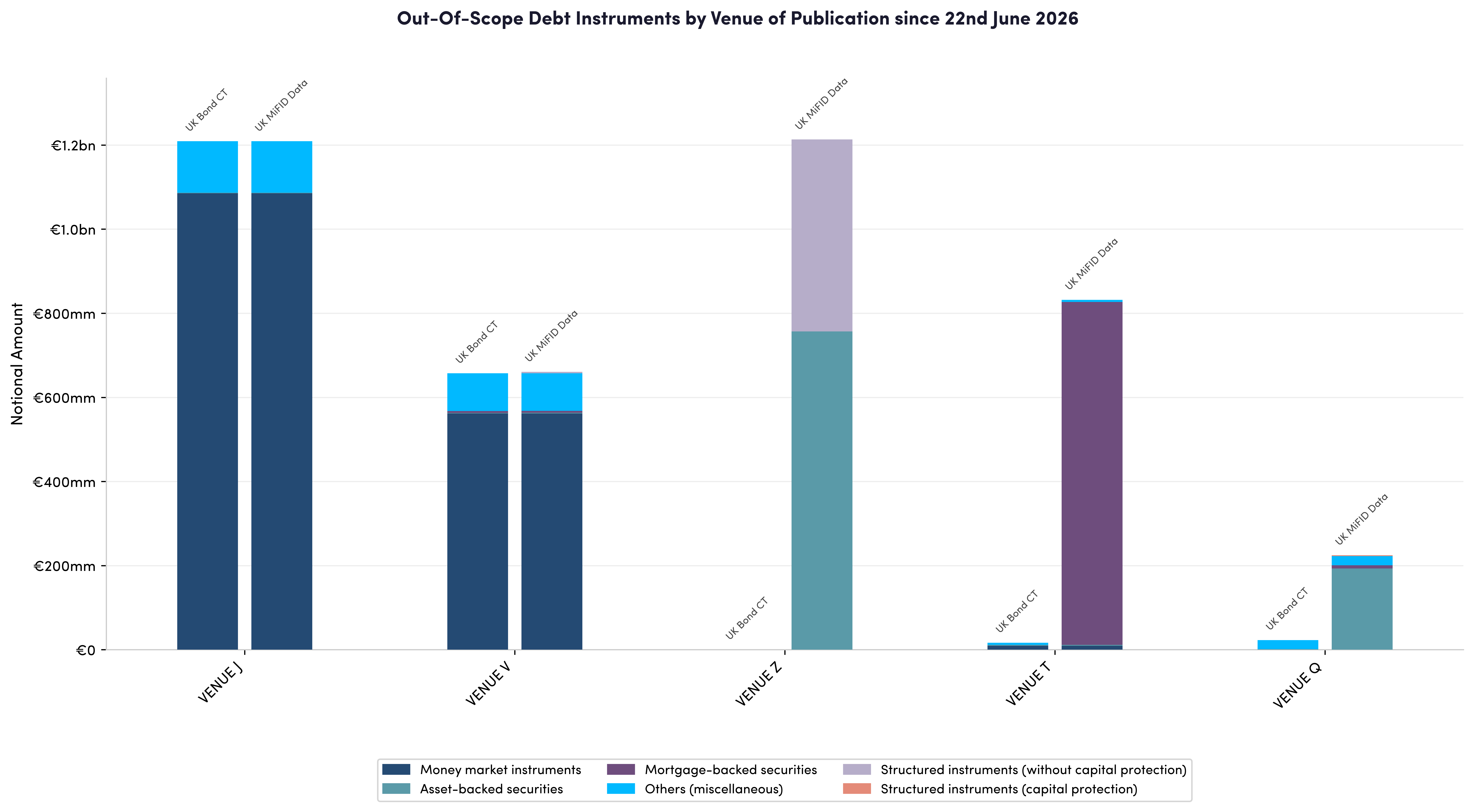
Venue T and Venue Z report ABS/MBS and structured products via MiFID, but not via the CT. This is exactly what we would expect as these instruments are out of scope.
Venue’s J, V and Q, however, report (mainly) money market instruments via MiFID and the CT, this may appear surprising as these are out-of-scope for both MiFID* and CT reporting!
“As reference data differs between providers, some may classify money market instruments as a short dated or zero coupon bond instead of a bill. This could explain why we often see money market instruments in MiFID reporting. The CT, however, prescribes in scope CFI codes so it is perhaps more unexpected they appear here.”

%20(10).png)
%20(9).png)