

G10 sovereign issuers have received large amounts of media coverage in recent weeks with higher yields attracting attention. French government bonds are no exception and have been the subject of focus for many, due to the increasing spread over German government bonds, however what impact might this have on French banks?


G10 yields have been increasing, with the increases (in some cases) fairly rapid in recent weeks1. As the focus today is on France, we first compare the yield curves of France and Germany.
German government bonds are typically considered as ‘benchmarks’ for fixed income securities denominated in EUR. Many instruments (typically government and corporate bonds) are quoted on a relative basis to the appropriate German government bond.
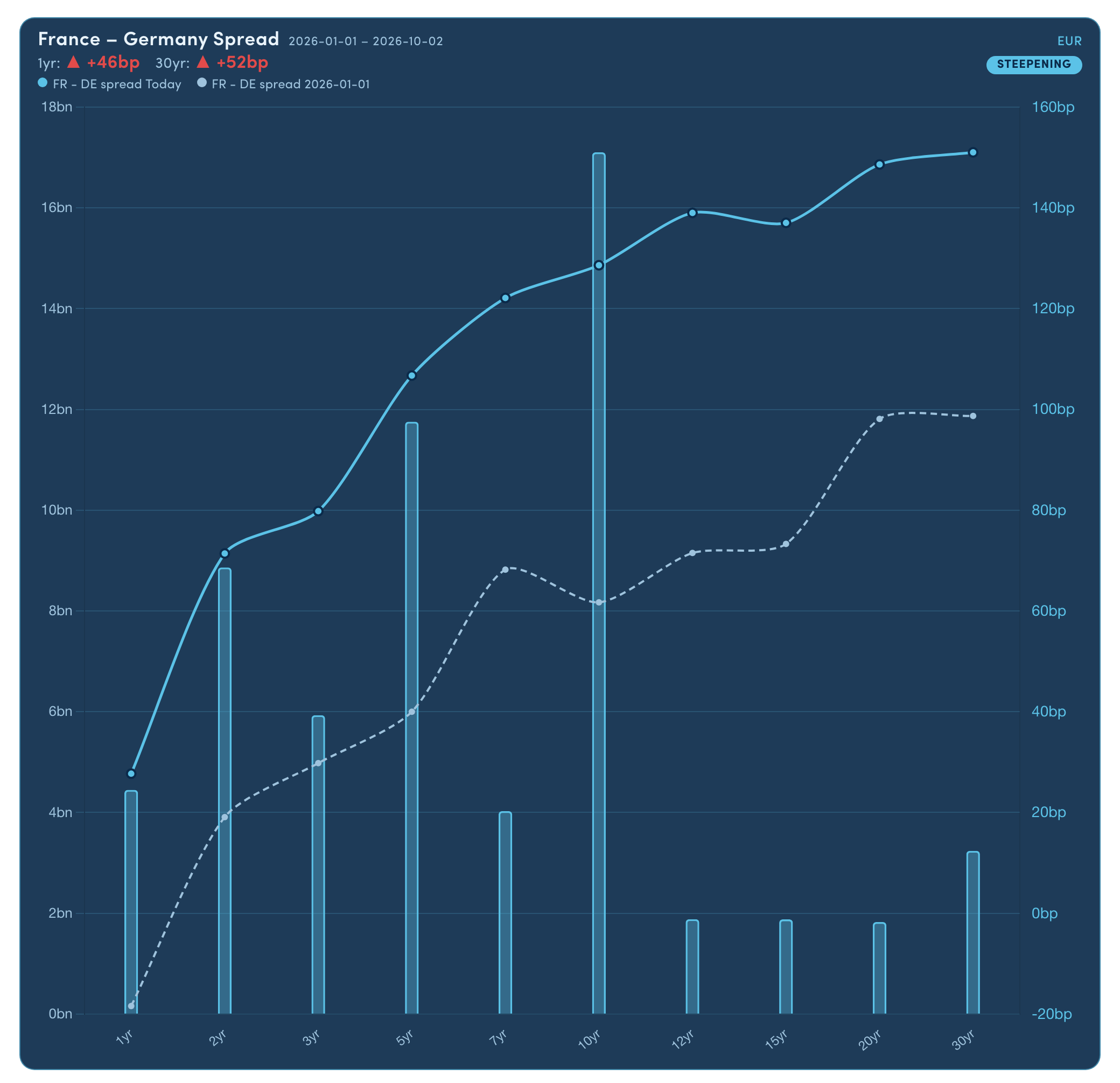
Chart 1 above shows us that French yields have increased by approximately 50 basis points (across the various tenor points) on average. This is known as ‘widening’ and the implication being that in order to hold French debt instead of German debt investors require an increased premium compared to what they required at the start of the year.
Our next consideration is what happens to the banks, if the sovereign yields widen?
There are far too many financial institutions in France, for us to examine every one, so in the name of berevity we will focus on the largest 3 by market capitalisation. These are BNP Paribas, Crédit Agricole and Société Générale2.
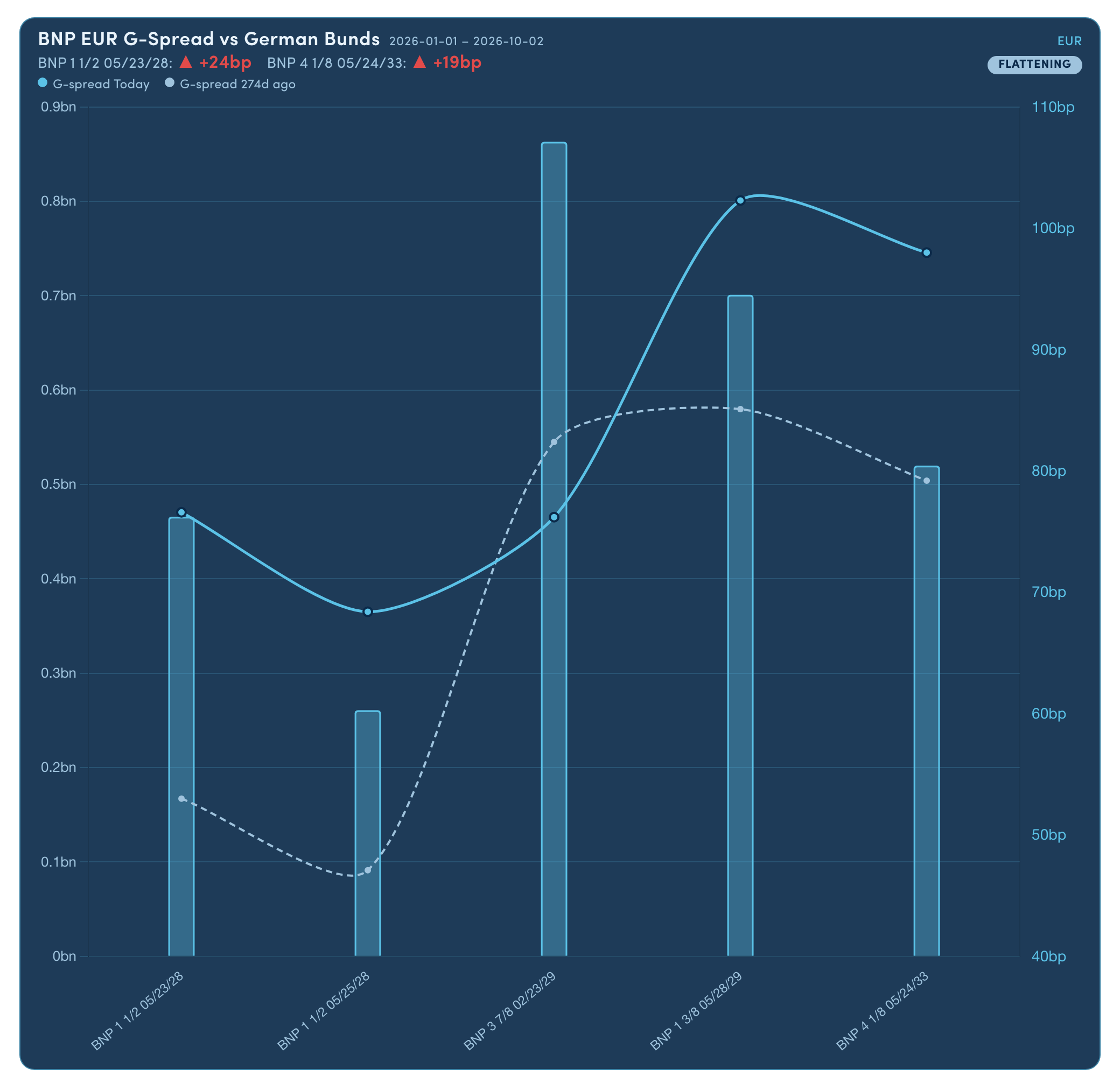
Starting with BNP (the largest bank by market cap), we can see that (as one might expect), the yield has risen, in a similar fashion to the underlying benchmark curve.
As with the French sovereign we compare to the German government bond curve (which is a proxy for the EUR risk free rate), however there is one important nuance. Here we are calculating the ‘g-spread’ which compares the yield of the corporate bond to the matched point on the government bond curve (there may not be a bond with a perfectly matched maturity, so we must use interpolation here).
Looking at Credit Agricole (ticker ACAFP), we can see that bonds with an approximate maturity of 8 years yield between 90 - 120 basis points over the German curve, which is similar to both BNP and the French sovereign (we allow some tolerance due to mismatched maturities and differing spread calculation methodology).
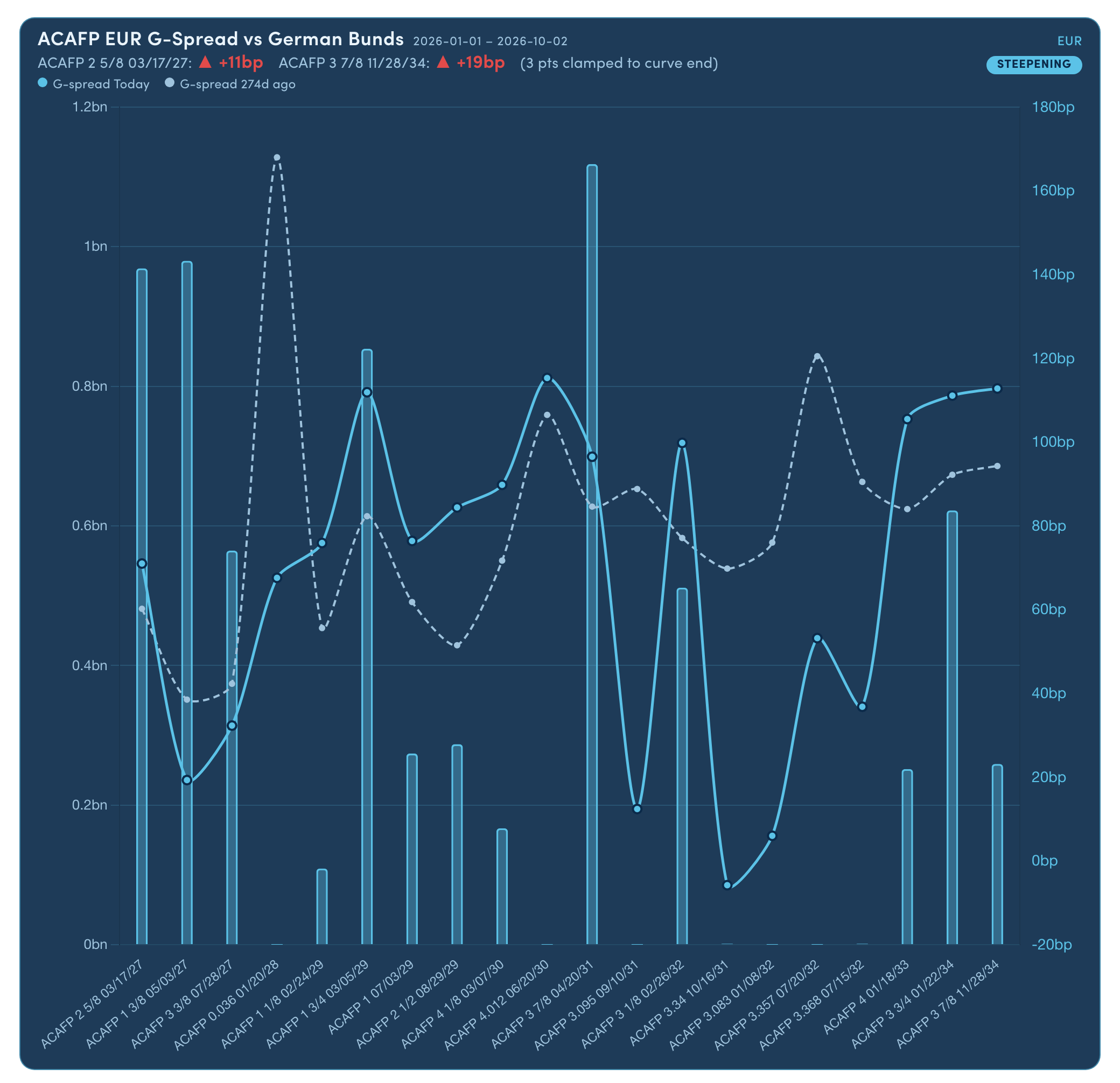
The Crédit Agricole curve has a lot of issues, more than showed up on the BNP curve. As per usual we aim to keep things simple by using the reference data contained within ESMA’s Financial Instruments Reference Data System (FIRDS). This allows us to filter out subordinated debt, but does not allow us to differentiate between senior preferred and non-preferred. To get more granularity, we could split these out to account for the slightly different risk profiles.
That said, it is surprising to see that some reported trades do suggest that Credit Agricole debt is being priced as slightly less risky than the sovereign itself at some tenors (albeit we must acknowledge that the spread calculations both use a slightly different approach, so whilst we can state this as an approximation, we can not be 100% confident).
We finish up this week, looking at the 3rd largest French bank (at the time of writing), Société Générale (ticker SOCGEN).
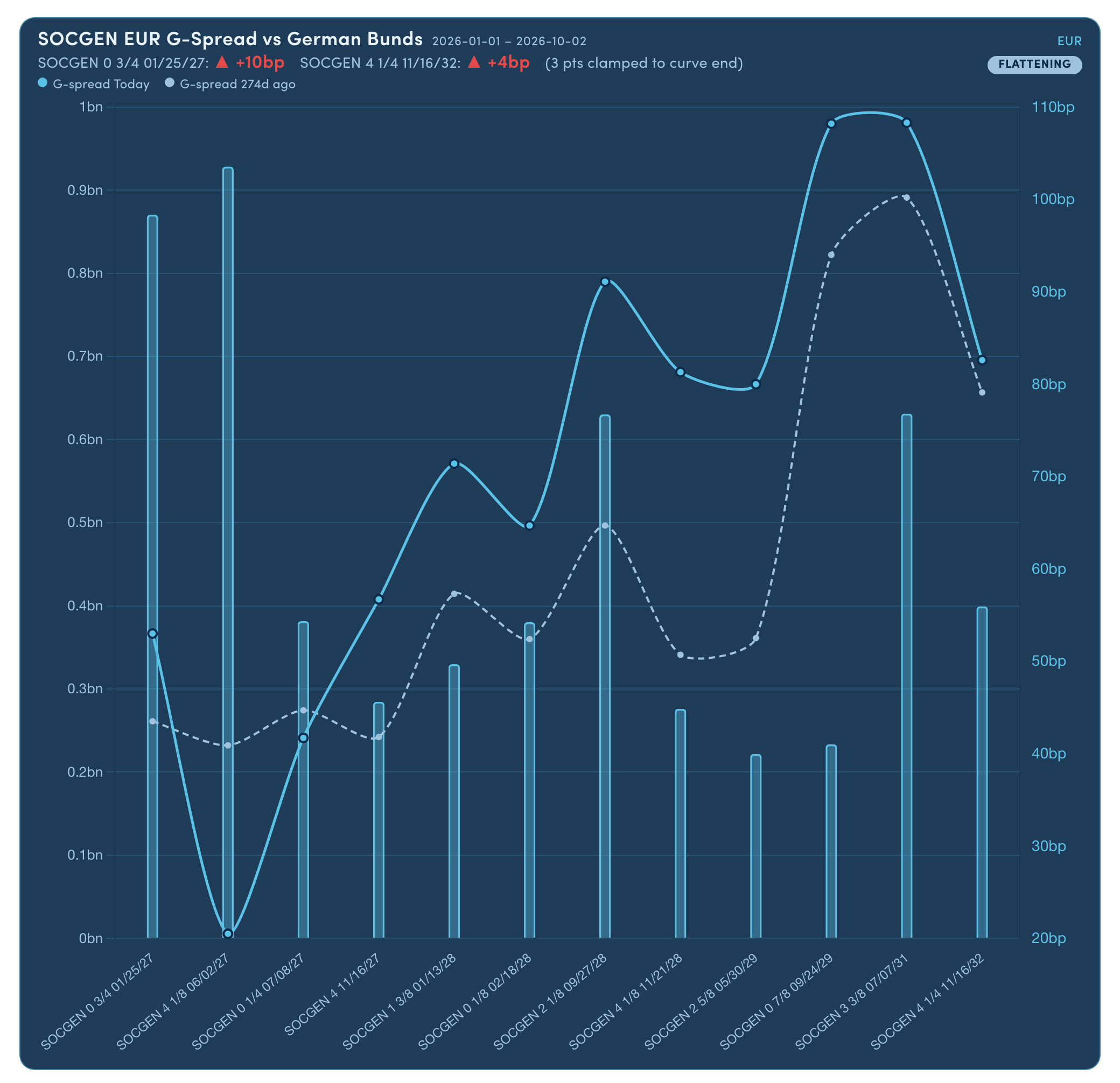
Société Générale trades with a larger spread to German government bonds at certain curve points, and in-line with the other banks at others, additionally the debt profile differs, in that the longest dated bond reported via MiFID matures in 2032.
“French bank yields have undoubtably increased over the year, albeit the order of magnitude differs based on the individual risk profile associated with each bank.
In order to draw further conclusions we need to split out the senior preferred and non-preferred debt, so we can observe the yield differences between the two.”

Vidal Mehra - Vidal is Chief Product Officer for Propellant Digital and the lead author for Propellant Insights.
He has been working with financial institutions for over 20 years across multiple disciplines including front office and consulting roles.
Helena Roughton - Helena recently joined the team as a Product Manager, bringing extensive MiFID policy experience having previously worked at AFME.
She also brings product remediation and data analysis experience from the Bank of New Zealand.
%20(12).png)

%20(11).png)