%20(6).png)
Nordic Fixed Income has a reputation for being strong, slow and steady, but how does MiFID transparency impact an already mature market and is there much actively traded outside the region?
This week we look into Nordic bonds and swaps to see what is really happening!


When thinking of the Nordic countries, a few things probably come to mind, hygge1 culture is likely to be one of them, perhaps carving your way down a World Cup run in Åre2, or maybe (switching to the more famous and recent World Cup) it’s the now infamous viking row3.
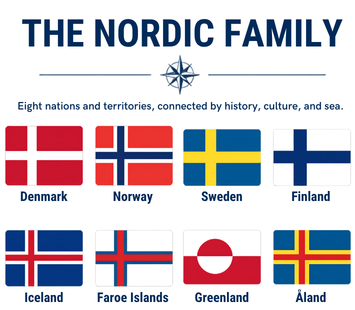
However before we get too far into the Nordics, we should first define what we mean, with the various territories making up the region shown in figure 1 below:
Regular readers will know that we have (at least partially) looked into the region before with our covered bond analysis in Propellant Insights 22 and an ill fated attempt to find Greenland bonds back in Insights 16.
This week however, we aim to go deeper, looking at not just bonds, but derivatives too!
The Nordic bond markets are often cited as being sophisticated5 and this is reflected in the commitment to transparency within the region, exemplified by the Nordic region’s local service, Stamdata6.
This service provides Nordic fixed income data and is commonly used by market participants within the region. To see the full picture it is necessary to look at the available data published via MiFID (outside the region), so that is the primary focus here as opposed to Nordic reporting.
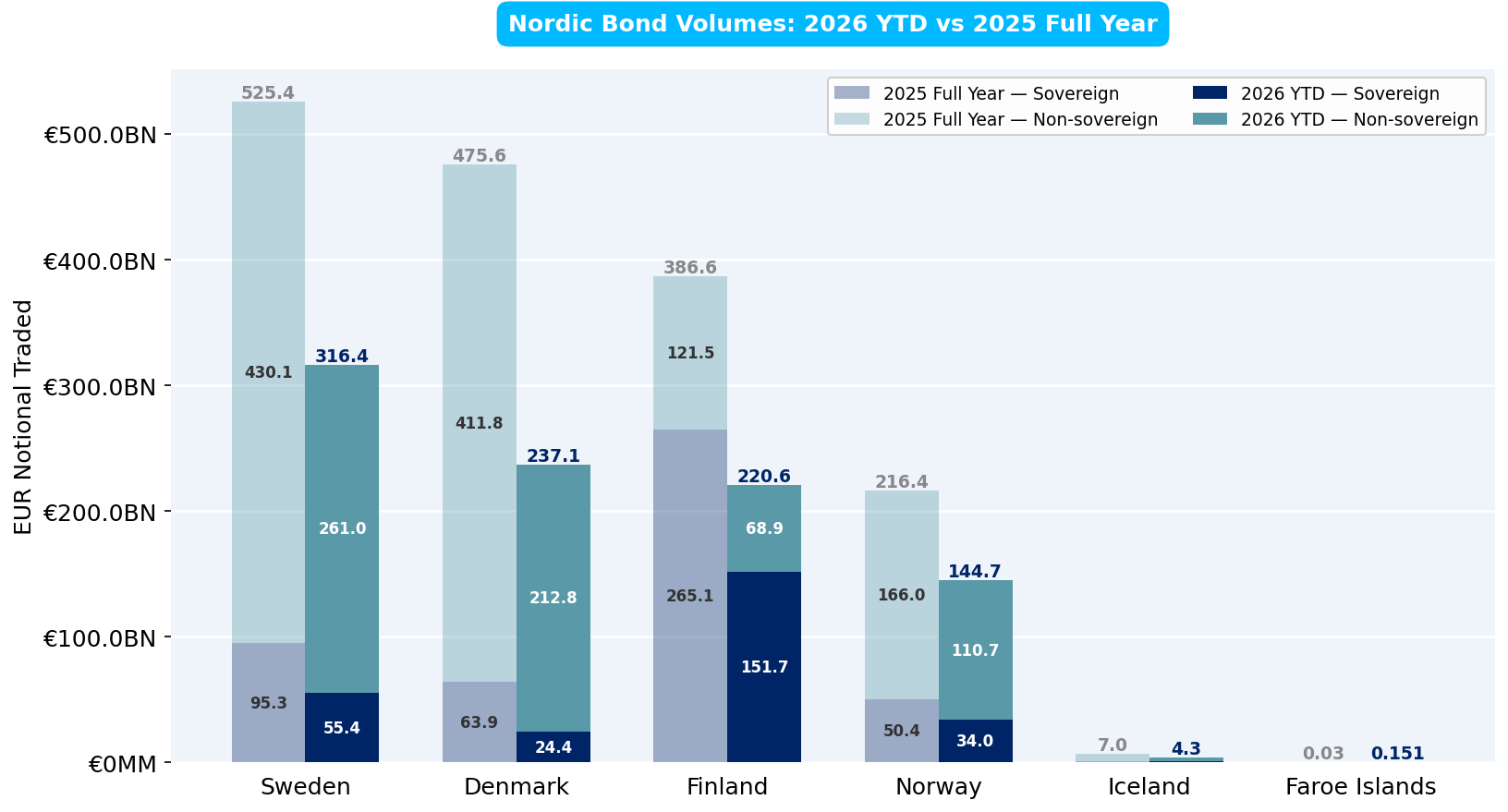
Chart 1 above shows us that there are substantial flows reported outside the region via MiFID trading and reporting venues. What is most striking is the amount of credit flow (although it should be noted in this context we break down sovereign and non-sovereign, meaning some SSA flow will be included in the non-sovereign category).
Additionally we can see activity from the smaller nations, namely Iceland, but perhaps the biggest surprise of all is that we see millions of Danish Krona flow (shown above in EUR equivalent) on issuers from the Faroe Islands!
IRS denominated in currencies other than USD, EUR and GBP have largely been (or will shortly be) de-scoped from MiFID price dissemination (with the exception of JPY swaps, which will remain reportable under ESMA rules). DTCC however shows data from a far broader range of currencies, including IRS booked in the Nordic currencies.
Chart 2 below shows us that some Nordic currency IRS are still being reported via the FCA and ESMA, but it is clear that the DTCC proportion of activity is increasing, which may reflect the changes in reporting.
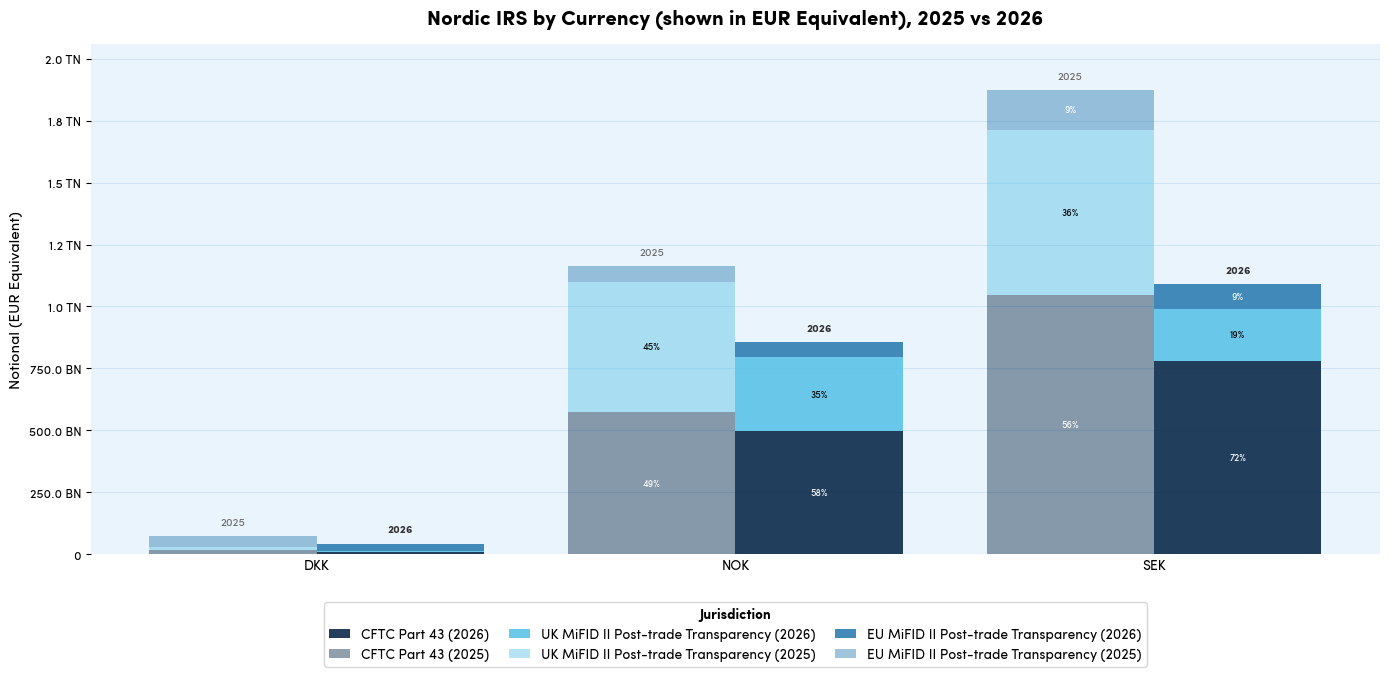
Given Finland uses EUR it would not be practical to include that here (as only a small percentage of activity could be attributed to Finland (or Åland), with it being close to impossible to separate). The Faroe Islands and Greenland both use DKK (Danish Krona), so that just leaves Norway, Sweden, Denmark and Iceland. We could not find any Icelandic Krona (ISK) activity reported (but it is important to note that Iceland is not an EU member, so this is perhaps not surprising, with most activity likely to occur domestically).
In Chart 2 the lack of Danish Krona activity is the main surprise, with both Swedish (SEK) and Norwegian (NOK) activity more than 10 times larger. However, when we consider the nature of the Danish market, this is explainable, as it is likely most is reported domestically and whilst subject to ESMA reporting requirements, Nordic region reporting was explicitly out-of-scope here (we will however take a look at that in a future issue).
One special note should be made for Credit Default Swaps (CDS). We had intended to show data for these too, however the Nordic (sovereign) credits are so stable the CDS rarely trades, meaning even in DTCC there was insufficient data available to produce any meaningful charts!
“Transparency within the Nordic region is arguably better than in most areas around the world, however, given the amount of flow seen (or at least reported) in Central Europe, the US, and the UK, it remains essential for market participants to ingest data from all of these jurisdictions in order to get a complete picture.”

1https://denmark.dk/people-and-culture/hygge
3https://www.visitnorway.com/typically-norwegian/the-viking-row/
4https://www.norden.org/en/information/facts-about-nordic-countries
5https://www.nordea.com/en/news/the-cost-of-flexibility-is-less-than-the-cost-of-financial-distress

Original photograph taken by Richard Hadley
Dan Barnes - Dan is a highly experienced market commentator and founder of multiple media ventures including Trader TV and The Desk.
He is contributing as a guest editor for Propellant Insights ahead of starting a new venture in Q4 this year.
Vidal Mehra - Vidal is Chief Product Officer for Propellant Digital and the lead author for Propellant Insights.
He has been working with financial institutions for over 20 years across multiple disciplines including front office and consulting roles.

Helena Roughton - Helena recently joined the team as a Product Manager, bringing extensive MiFID policy experience having previously worked at AFME.
She also brings product remediation and data analysis experience from the Bank of New Zealand.
%20(10).png)
%20(9).png)